Showing posts with label alberta. Show all posts
Thursday, February 25, 2016
Clay Crest
Last month Grade 4 constructed the Alberta provincial crest out of clay.
The students did a terrific job and they were quite proud of them. Great tie in with social studies.
Now you could adapt this to fit whatever province you are in.
MATERIALS REQUIRED:
- 1 box of low fire clay, buffstone or white for each class
- fabric mats, optional (if you work a lot with clay this are handy to have)
- rolling pin
- wooden skewer, penny nail
- small cup of water
- reference photos of the crest
- glazes or acrylic paint depending on what finish you want
PROCEDURE:
I pre roll all the slabs for the class.
Cut a 1inch thick slice off the clay block, place on your fabric mat and roll to about 3/4's of an inch even thickness.
I will place these on a garbage bag that I have cut open, (down 1 side and across the bottom. I usually have mine on a cart as I'm moving from room to room. I can get 6 or 8 on the top of the cart. I then fold over the end of the garbage bag to cover the slabs and put another layer on top.
I will pre roll all I need for a morning or afternoon and the plastic garbage bag keeps the clay soft.
In the classroom each student gets a mat, a wooden skewer, a nail, and they share a small cup of water (every 2 kids).
We look at our reference material, I draw out the shape of the crest on the board and then I get them to first trace the shape using their finger onto the slab.
I like to check them before they cut to ensure the size is large enough and that the shape is good.
If they need to trace it out again just rub a little water on the surface to smooth out the 1st attempt.
Using the nail cut out the shape.
I get them to dip their finger in water and smooth the edges.
Using the skewer we lightly divide our shape into 3 sections.
I stress lightly as we don't want to cut our shape, it's just a line on the surface of the clay.
I asked them to make the middle section the largest as we have a lot to fit in there.
We start at the top of the design and work our way down.
For the cross we cut a long strip. I remind them that we use the nail for cutting and the stick for scratching.
By now they are very used to my 'scratch, scratch, water, water' chant but we say out loud a few times to remind everyone.
To attach the strip we make surface scratches (scoring) both on the crest and the strip. (scratch, scratch)
We then dip our finger in the water and rub a little on the scratches. (water,water)
I tell the kids you then get the scratches to kiss and that is how we glue one piece of clay to another.
The kiss analogy works great, they never forget it.
Cut 2 little strips for the rest of the cross.
Continue working through the sections using the 'scratch, scratch, water, water' method to add your pieces.
With the mountains you can make it all in one piece or indvidual ones.
For the wheat stalks I showed them 2 methods.
- cut a strip and scratch on the kernels or
- form each kernel seperately and add or
do both.
When finished we gently turned over in our hands ( a partner can help) and scratch our name and year onto the bottom.
Set clay crests aside somewhere on paper towels to dry out undisturbed.
I tend to use the tops of the bookcases in the library.
Depending on your climate the clay will dry out in 1-2 weeks. To check hold it up to your cheek. I find clay is always a bit cold even when dry but if it feels damp give it more time.
Do the bisque fire when dry. You can then paint using clay glazes (I love Mayco Stroke and Coat) or acrylic paint.
If you choose glaze it will need to be fired a second time.
Great job Grade 4!
Gail
Tuesday, November 3, 2015
Alberta Postcards
This Fall I have done a lot of these 'postcard' projects.
It's an image that would be on a tourist postcard but we make it canvas sized.
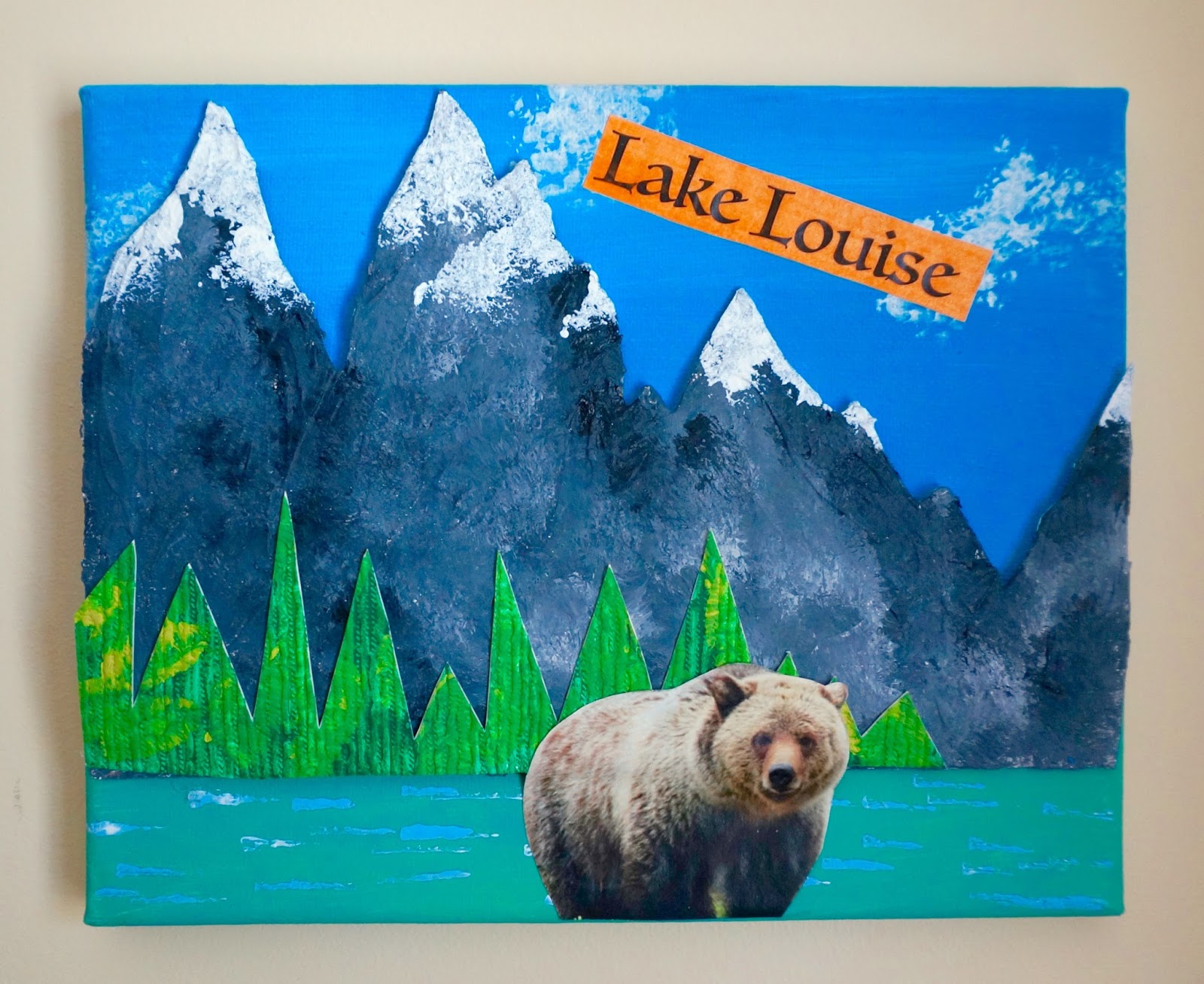
I have made similar ones for the Taj Mahal and Machu Pichu that tie into the Grade 3 social studies curriculum. These Alberta ones tie into social studies for Grade 2 and 4. We looked at 3 regions, prairies, forests, and mountains.
The 'Jasper' moose one is a variation of the Moose in the wild projects I posted earlier.
You can take these techniques and apply them to whatever region you are studying. It just goes to show how versatile the drywall filler on cardboard technique is.
MATERIALS REQUIRED:
- recycled cardboard
- drywall filler
- substrate, canvas, cardboard or hardboard
- acrylic paint
- tacky glue, glue gun for the more stubborn pieces, (adult use only)
- black scrap paper for prairie scene
- printed text titles
- textured wallpaper or paper
- photos of animals
PROCEDURE:
Using your substrate to measure how large your pieces should be, cut out the parts you wish to drywall. We used a mountain, aspen tree trunks, and a grain elevator.
Apply a generous amount of filler on the cardboard. You need to use the brown or grey side if you are using a cereal box. The coloured side has a shiny finish that the drywall won't stick to when dry...it just all flakes off.
I leave the pieces on wax paper to dry. (6 hrs - overnight)
You may find the pieces curl while they dry just gently bend them back the best you can. The really curvy ones will get glued on with the glue gun.
To create the hay bales we cut out circles and with the glue drew in some spirals. Leave overnight to let the glue dry.
I use tape with the younger grades to create a STOP guideline for painting.
All 3 regions need a nice blue sky. We used turquoise acrylic. With the canvas we wrapped the colour around the sides and the top.
When the kids reach the tape they STOP....or at least that's the theory.
When the drywall is dry it's time to paint.
For the aspen tree trunks we just sponged on some black and grey.
For the prairie one we painted the grain elevator red.
For the mountains we painted them black and grey. You can leave the tops white for snow or sponge on some white once it has dried.
Remove tape from canvas. You can place it above the line to help the kids with their horizon line when painting the ground.
We wrapped the colour around the sides again and the bottom edge.
Sponge on a few clouds, this is where you can sponge on that snow for the mountains as well.
For the mountain and forest regions we painted some textured wallpaper to make our trees. You can also use textured paper or pass it thru the crimper.
We used a piece of cardboard to stamp in some lines for all 3 regions.
For the prairie and forest it was for the grass or crops. For the Fall season we used yellow and brown. While you have that yellow paint out you can paint those hay bales.
With the mountain scene we turned the cardboard horizontal and stamped a few lines in white and blue for the ripples on the lake.
Cut a good tree line out of the textured paper. I tell the kids it's like shark teeth but we want a variety of sizes here.
For the forest glue the tree line in place and then the aspen trunks.
For the mountain we glue the mountain in place first, you may have to use the glue gun for the curvy ones.
The tree line sits at the bottom of the mountain at the water's edge.
This is from another project but shows how we stamped leaves onto our aspen trees. For fall we used autumn colours. I have a set of unsharpened pencils that I use for this.
For the prairie, glue the grain elevator near the horizon line. We used scraps of black paper for the roof lines and door. I printed off the Alberta wheat pool sign. You can email me at thatartistwoman@shaw.ca
if you need the logos and I can send them to you.
Glue on the hay bales.
We then added our titles that we printed off from the computer and our animals.
For the titles I added a quick paint wash for colour.
That's it.
Gail
Subscribe to:
Posts (Atom)